
First Coast Expressway Blueprint: Timelines, Neighborhood Impacts, & What’s Next for St Johns County
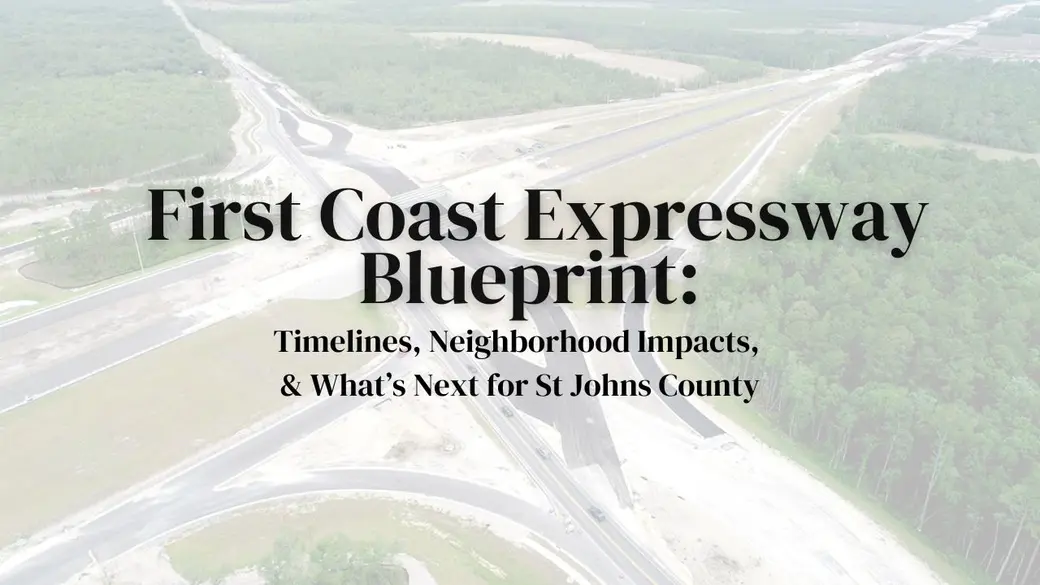
If you live in St. Johns, Clay, or Duval County, you’ve likely noticed the massive active construction reshaping our western corridors. We are currently witnessing the single largest infrastructure project changing the face of Northeast Florida: The First Coast Expressway (State Road 23).
This 46-mile, multi-lane limited-access toll road is going to completely transform how we commute, how our communities grow, and what property values look like over the next decade. We are moving rapidly from a long-term vision to active reality right in our backyard.
Here is everything you need to know about where the project stands, who is impacted, and what it means for the future of our region.
1. The Backstory: From Planning to Progress
The First Coast Expressway didn’t just appear overnight. The planning goes back over a decade, hitting a crucial milestone with the Final Environmental Impact Statement in late 2013 and a Record of Decision in early 2014. This finalized the route and permitted the crossing over protected areas and the St. Johns River.
To understand when relief is coming, it helps to look at the project in three distinct segments:
-
Segment 1 (Duval to Clay): This is the section residents already drive. Running from I-10 down to Blanding Boulevard (SR 21) in Middleburg, construction wrapped up in summer 2019, which is when the all-electronic SunPass/Toll-by-Plate system went live.
-
Segment 2 (Clay County): This segment runs from Blanding Boulevard down through Green Cove Springs. Split into two massive projects costing over $410 million combined, workers are deep in the final stages of construction, with completion on track for this year.
-
Segment 3 (The Crossing & St. Johns County): This is the main event for our local area, broken into three critical, funded pieces:
-
The New St. Johns River Bridge: Began in early 2023, this $595 million project is building a brand-new, high-clearance bridge just south of the narrow Shands Bridge. It will feature a shared pedestrian and bicycle path, with an expected completion in 2030.
-
The SJC West Connection: Running from east of the CR 16A Spur over to CR 2209, construction kicked off in late 2024.
-
The I-95 Interchange: Running from CR 2209 straight to I-95. Construction breaks ground early this year, aiming for the final corridor opening in 2030—two years ahead of original projections!
-
2. Neighborhoods & Communities Directly Impacted
While the expressway will change regional traffic patterns, a few specific local areas are experiencing the most dramatic visual and physical transitions:
SilverLeaf
The Expressway is routing directly through this master-planned community. This outer beltway is literally being built to handle the density here, giving residents a straight shot across the river to Clay County or a quick route down to I-95.
The CR 210 Corridor & Greenbriar Area (Shearwater)
Major connection points are taking shape near CR 16A, CR 2209, and the extension down to International Golf Parkway, fundamentally changing how residents navigate these high-growth areas.
World Golf Village / International Golf Parkway
As the expressway connects directly into I-95, the southern portion of this outer loop will actively relieve and shift the daily traffic flow around World Golf Village.
Rural St. Johns (CR 16A / Trout Creek Area)
Long-time residents in these historically quieter, rural pockets are seeing the most dramatic visual evolution, watching local two-lane roads transition to major expressway flyovers.
3. The Pros & Cons: A Balanced Look
Like any massive infrastructure shift, the First Coast Expressway brings a mix of major benefits and growing pains.
The Pros
-
Bypassing the I-295 Gridlock: Acting as a true western beltway around Jacksonville, it allows drivers traveling from St. Johns County to Orange Park or I-10 to completely bypass the daily headache of the Buckman Bridge and the I-295/I-95 junction.
-
Vital Hurricane Evacuation: Highlighted by the FDOT as a major safety benefit, this adds a high-capacity, multi-lane highway heading west out of the coastal zones.
-
Economic & Retail Growth: Interchanges at CR 2209 and SilverLeaf will fast-track highly requested commercial centers, dining, and healthcare facilities right to residents' backdoors.
The Cons
-
All-Electronic Tolls: There is no cash option on this road; commuters will need a SunPass or rely on Toll-by-Plate.
-
Construction Pain Points: With a final completion date set for 2030, residents can expect another four years of heavy dump truck traffic, lane shifts, and clearing along our western corridors.
-
Loss of Rural Charm: The quiet, wooded expanses of western St. Johns County are rapidly transitioning into modern suburban infrastructure.
4. The SilverLeaf Connection: Case Study in Growth
To truly understand why this road is being built, look no further than the timeline of SilverLeaf, which highlights how local development and infrastructure are deeply intertwined:
-
2018–2019 (The Vision): The Hutson Companies began site work, logging, and infrastructure grading, paving the way for the very first model homes.
-
2020–2021 (The First Wave): The initial neighborhoods opened, residents moved in, and the massive resort-style amenity center debuted.
-
December 2021 (The 16,300-Home Milestone): The St. Johns County Commission approved a massive 2,300-acre expansion. This bumped SilverLeaf's ultimate capacity to 16,300 residential units, 2 million square feet of retail, and nearly 1 million square feet of office space.
The Grand Plan: During that pivotal 2021 expansion meeting, developers explicitly pointed out that traffic from these thousands of new homes would be successfully managed because the neighborhood's growth was designed to perfectly coincide with the timeline of the upcoming First Coast Expressway.
-
Today (The Reality): SilverLeaf has transformed from a blank canvas into a booming suburban hub. It is currently moving past just housing and bringing major commercial services online, including the new Publix shopping center (SilverLeaf Commons), a 24/7 Baptist Emergency Room, and a brand-new K-8 school slated to open for roughly 1,500 students this August.
While SilverLeaf isn't projected to hit its final build-out until 2047, its trajectory is completely dependent on the transit artery currently being built next to it.
The Bottom Line for St. Johns County Property Owners
St. Johns County remains one of the fastest-growing counties in the entire nation, having grown by a staggering 40% between 2010 and 2020 alone.
In the long run, the First Coast Expressway turns western St. Johns County into a highly accessible, premier suburban hub. It ties us directly to the employment centers of Clay and Duval without requiring us to squeeze through the central bottleneck of Jacksonville's traffic.
If you own property along CR 210, CR 2209, or in the major master-planned communities nearby, your long-term accessibility just skyrocketed—but the days of these areas feeling like a "hidden pocket" of the county are officially over.
What are your thoughts on the new expressway? Are you looking forward to the shortened commute, or will you miss the rural charm of the western corridor? Let’s discuss in the comments below!
Categories
Recent Posts








GET MORE INFORMATION